
Douglas Projected and Actual Release
IDOC uses the exact field label Projected Discharge Date. That date concerns the expected end of a correctional obligation and may be later than the Parole Date, which can mark physical release from prison to community supervision. The field can also read “TO BE DETERMINED.” It should not be renamed or treated as a promise.
A Douglas County Jail release is a different event. A pretrial detainee's timing turns on the court order, processing, and any other hold. A person serving a local sentence must compare the commitment order, credited time, weekend-sentence instructions when applicable, and Sheriff record. Transfer to IDOC, another jail, federal custody, or ICE ends one agency's custody without proving community release.
Find Douglas County Projected Release
Choose the route from the custody type. The IDOC search applies after a person enters state corrections. It does not calculate a county-jail term. The Douglas Circuit Clerk and Sheriff are the key sources for a county sentence or pretrial case.
- Confirm the agency holding the person. Use the current Douglas jail path for county custody and IDOC only after state admission is established.
- For IDOC, open the working Individual in Custody Search. Search by IDOC number, birthdate, or last name and match more than one identifier.
- Read Offender Status and Location first. Then compare Admission Date, Parole Date, and Projected Discharge Date.
- Review every sentence count, including County, Custody Date, Sentence, and “Sentence Discharged?: YES/NO.” A Douglas count may coexist with another count.
- For county custody, search the Douglas Judici docket and obtain the signed order from the Circuit Clerk when wording matters.
- Confirm actual release or transfer with the Sheriff record. Absence from the current population is only a clue.
The broader Douglas County release search explains how to pair court authority with a release timestamp and destination.
Illinois Credit Shapes Douglas Release
Illinois has no universal rule that everyone serves the same share of a sentence. 730 ILCS 5/3-6-3 groups offenses and credit rates. Some first-degree murder, terrorism, and natural-life categories receive no sentence credit under the stated provisions. Enumerated offenses with no more than 4.5 credit days per month create the framework often called 85 percent. Specified offenses with no more than 7.5 days per month produce a 75 percent framework. Many non-enumerated sentences use one day of credit for one day served, often called 50 percent.
Those summaries do not calculate an individual's date. Offense date and governing version of the law matter. Additional program, service, or discretionary credit requires statutory eligibility and is not assured. The law preserves minimum-service floors, including the stated 85 percent floor and special rules for 75 and 100 percent categories. IDOC's earned discretionary sentence credit rule also relies on eligibility and assessment.
Presentence custody credit can reduce remaining time when the mittimus, the court's commitment document, awards it. Concurrent terms generally run together; consecutive terms change the total structure. Only the judgment and IDOC calculation can resolve a particular case.
Why Douglas Release Dates Change
A changed projection is not automatically an error. IDOC recalculates from legal and administrative inputs. A receiving hold may also change where the person goes even when the releasing agency's date stays the same.
| Factor | Possible effect |
|---|---|
| Credit award | Eligible statutory, program, or discretionary credit may move a projection earlier. |
| Credit revocation or restoration | An authorized disciplinary process may move the date later or restore time. |
| Presentence credit | A mittimus or corrected order can alter time credited before prison admission. |
| Concurrent or consecutive counts | The aggregate sentence structure changes how multiple terms combine. |
| New court order | Modification, correction, or a later sentence can require recalculation. |
| Detainer or hold | Another agency may take custody, so prison or jail exit is not community release. |
| Parole or MSR status | Prison exit may occur before final Projected Discharge Date. |
IDOC master-file policy identifies sentence-calculation sheets, credit approvals, credit revocation or restoration material, release-date notices, checklists, parole packets, and release packets. Those names make a focused records request more useful than asking for every document.
Confirm Douglas County Actual Release
A live projection should be checked again near the date. IDOC warns that records can change quickly. For a state case, match the person in the IDOC search and contact public information when a material discrepancy remains. For a county case, the Sheriff record should show the release or transfer timestamp and disposition, while the signed court order explains the legal authority.
Illinois VINE can add an alert from the matched source record. Register through the resolved VINELink Inmate Search and note whether the event says release, transfer, or another status. The alert is not an archive and does not prove the person's next location. Follow a named destination into IDOC, another jail, BOP, or ICE as appropriate.
Douglas Weekend Sentence Release
Douglas County publishes a Weekend Sentence Rules and Regulations document. Its presence confirms a distinct local process. The collected research did not safely establish the current reporting hour, release door, or a rule that shifts a weekend endpoint. Do not borrow those details from another county.
Compare the current PDF with the individual court order and instructions from the Douglas County Sheriff. A weekend sentence remains a county process, so IDOC's online Projected Discharge Date and prison-credit percentages should not be applied mechanically. If terms conflict, the signed order and current agency direction control the practical next step.
Douglas IDOC Record Details
The modern IDOC page routes to a legacy search form. Results are session-driven, so a copied detail URL may fail later. Record the search method and access date. Partial surname searches can broaden results, while an IDOC number is more precise when known.
The sentence block deserves a full read. Mittimus ties the prison entry to a court commitment. County helps distinguish a Douglas sentence from a different county's count. “Sentence Discharged?” applies to one count, not the whole person. If an old record is missing, use IDOC's “Record Search” contact route or a narrow FOIA request rather than calculating a replacement date.
The official IDOC search landing shows the route used for Illinois records.
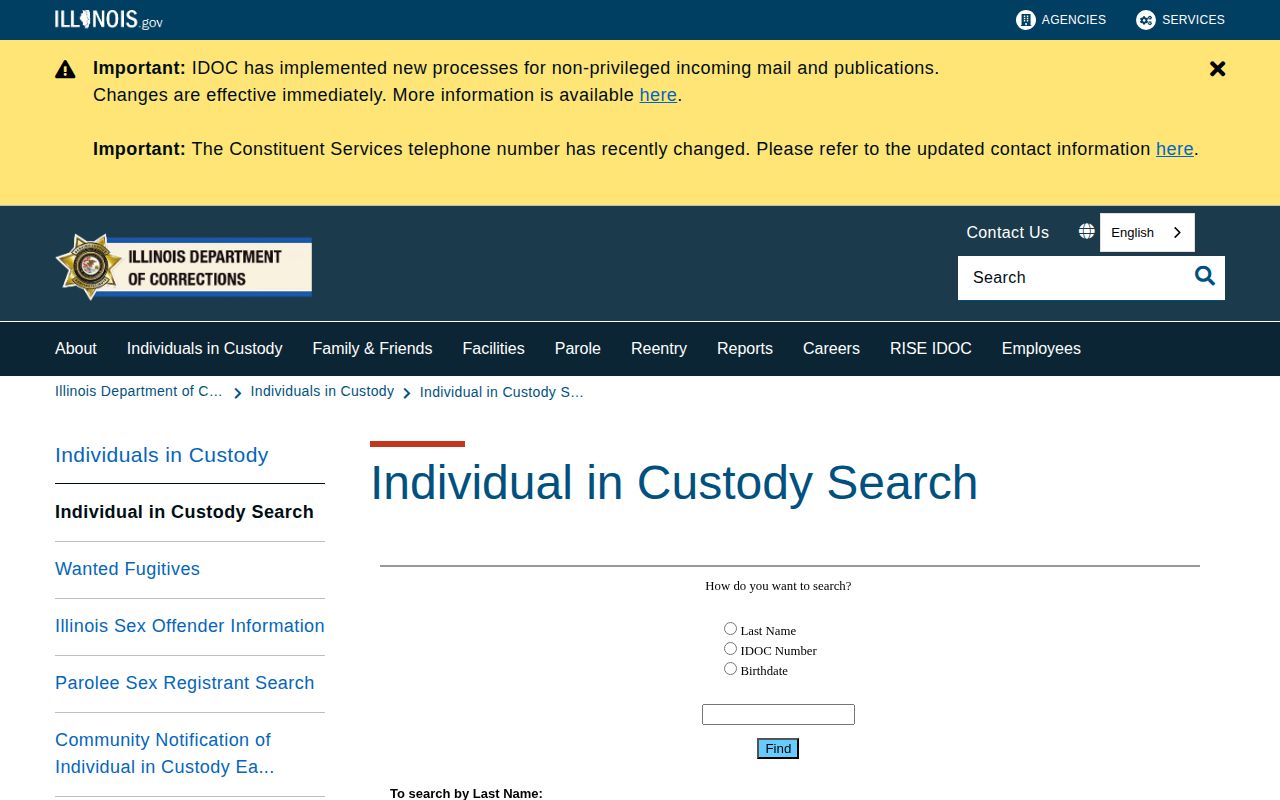
The image marks the correct statewide starting point; the live detail must still be read in the same search session.
Douglas Release Record Requests
When the public fields do not resolve a state projection, ask IDOC for named records such as the calculation sheet, release-date notice, or release checklist. IDOC publishes a five-working-day FOIA response framework with a possible written five-day extension. Its posted copy fees begin after the first 50 black-and-white letter or legal pages. Exempt information may be redacted.
For Douglas County custody, ask the Sheriff for the booking and release log entry, exact release date and time, disposition, and receiving agency if the event was a transfer. Ask the Circuit Clerk for the relevant signed order. The strongest conclusion names the releasing agency, event, date, and next status rather than relying on a projected field alone.
Read Douglas Sentence Counts Together
An IDOC detail can contain several sentence counts. Each count lists fields such as Mittimus, Class, Count, Offense, Custody Date, Sentence, County, and whether that sentence is discharged. The County field can connect one count to Douglas County, but another active count from elsewhere may still control custody. A “YES” beside one sentence does not establish final discharge for the whole record.
Start with overall Offender Status and Location, then test the dates against all counts. Admission Date shows entry into the state system. Parole Date may show the point of prison exit to supervision. Projected Discharge Date concerns the expected end of the broader correctional duty. If Location reads PAROLE or status reads ABSCONDER, the person is outside an institution but may remain under legal custody. Absconder is not automatic proof of a Douglas County warrant.
A no-result also has limits. The person may never have entered IDOC, may appear under different identifying data, may belong to another state or federal system, or may need archived-record assistance. Conversely, a matching name does not prove a current Douglas connection. Match birthdate or IDOC number when available and confirm the sentencing County and dates.
Douglas Transfers Change the Answer
A projected date answers only for the agency displaying it. If Douglas County releases a person to IDOC, the county event is a transfer and the state record becomes the next source. A detainer from another county, the U.S. Marshals Service, or ICE can produce the same pattern: one custody ends while another begins.
For a documented federal case, BOP may show a future projected date or a past “RELEASED” result. That ends BOP custody only and does not rule out supervised release or another hold. ICE's public locator has a short post-release window and is not a historical archive. Always follow the destination named in the Douglas release entry instead of treating the first agency's end date as proof of arrival in the community.
Douglas Court Credit Records
The Douglas County court file can supply facts that a public custody screen cannot. A mittimus may state the sentence, custody credit, concurrent or consecutive structure, and the agency to which the person is committed. Later orders may correct a clerical point or change the legal inputs used by the jail or IDOC. Review the chronology and obtain the signed document when a docket label is too short to interpret.
A court order still does not prove that release processing finished. Pair it with the Sheriff release entry for county custody or with the updated IDOC detail for a prison case. If the two sources differ, record the access dates and ask the proper custodian to resolve its own record. Avoid estimating a date by subtracting a popular credit percentage from the sentence because offense date, statutory category, prior custody credit, and later credit decisions can change the result.
Public Record Search
Sponsored Results