
IDOC Release and Supervision Paths
IDOC operates Illinois state prisons for people committed under state sentences. No IDOC institution was identified inside Douglas County, but a Douglas County court can issue a mittimus that sends a sentenced person into state custody. A Douglas County Jail transfer to IDOC ends the county jail hold and begins state custody. It is not community release.
When institutional custody later ends, the person may enter parole or mandatory supervised release, often called MSR. IDOC Parole Division performs field supervision, while the Illinois Prisoner Review Board sets conditions and handles its statutory hearing functions. A person can be outside prison yet remain in IDOC legal custody until final discharge. The IDOC record may show Location “PAROLE,” a Parole Date, and a future Projected Discharge Date at the same time.
Search IDOC Douglas Records
Use the working IDOC Individual in Custody Search. Search by last name, IDOC number, or birthdate. The last-name option can accept a full, surname-only, or partial entry, but a common name demands stronger identifiers. The detail page is session-driven, so a copied result URL may not reproduce later.
- Search with the most reliable identifier available. Prefer an IDOC number or birthdate when names could collide.
- Open the matching detail and verify name, IDOC number, birthdate, and identifying information.
- Read overall Offender Status and Location before interpreting any date.
- Compare Admission Date, Parole Date, and the exact label Projected Discharge Date.
- Review each sentence count, including County, Mittimus, offense, custody date, sentence, and “Sentence Discharged?: YES/NO.”
A single count marked YES does not prove final discharge if another count remains active. “TO BE DETERMINED” is not a date and should never be replaced with an estimate. A Douglas County connection is best supported when the appropriate sentence count identifies Douglas as the county.
IDOC Search Fields Explained
The IDOC detail can show Parent Institution, current Location, Offender Status, vital statistics, Admission Date, Parole Date, Projected Discharge Date, and sentencing information. Current records may include front and side photographs. IDOC states that public data changes quickly, so a saved result should include the access date and exact wording.
| IDOC field | Careful reading |
|---|---|
| Offender Status | Overall current classification; read with Location and counts |
| Location | Institution, PAROLE, or another status location |
| Parole Date | May mark prison exit, not final discharge |
| Projected Discharge Date | Projected end of the correctional obligation; may change |
| Sentence Discharged? | Applies to one count; all counts must be reviewed |
An ABSCONDER status means a supervision issue in the IDOC context. It does not, by itself, prove that Douglas County issued a warrant. Any warrant claim must be verified through the appropriate court or official warrant source.
View the IDOC Search
The legacy IDOC interface remains the working query route documented in the research. It is separate from the Douglas County Sheriff’s current-population app.
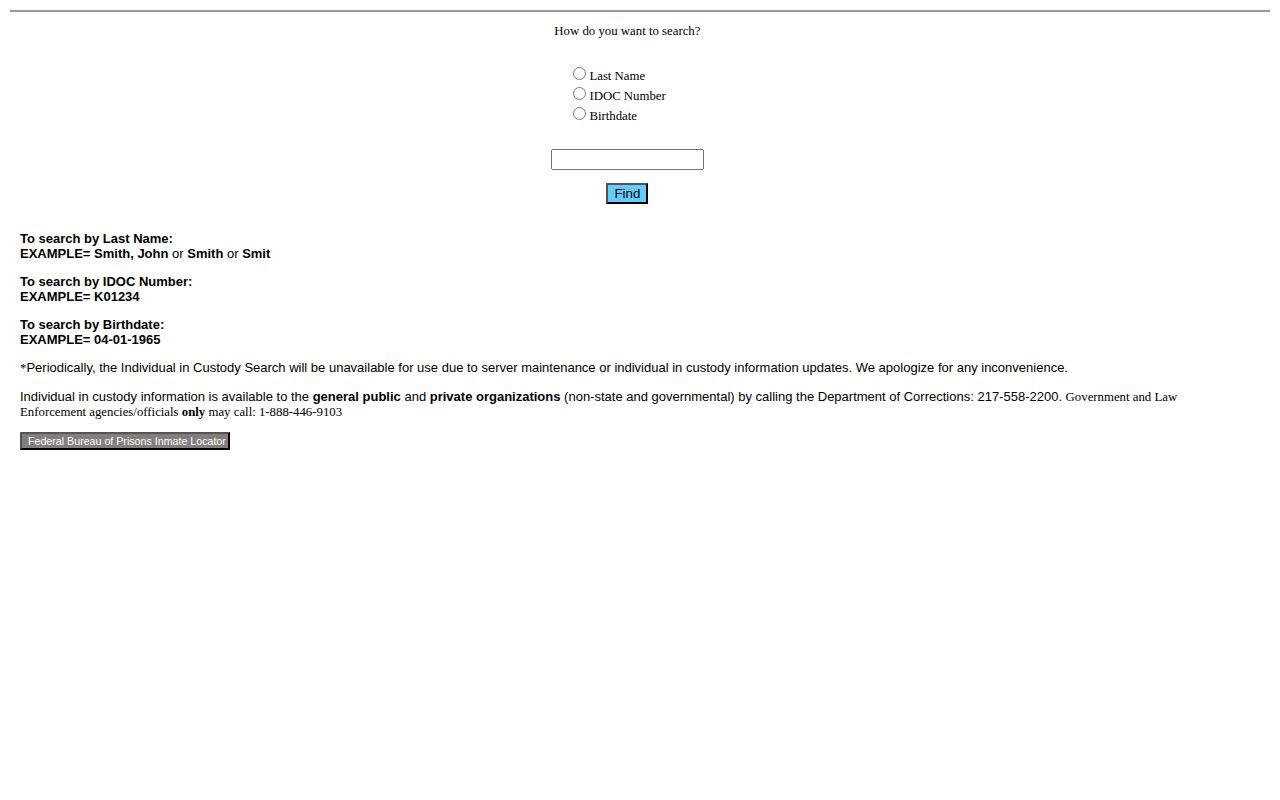
The form’s last-name, IDOC-number, and birthdate options lead to state correctional records. They do not cover a Douglas County jail-only stay that never resulted in IDOC admission.
IDOC Records and Contact
IDOC public information can be reached at 217-558-2200. Written verification may be directed to the Public Information Office, 1301 Concordia Court, PO Box 19277, Springfield, IL 62794-9277. IDOC Parole’s statewide number is 800-666-6744. There is no general public directory of every supervising agent, so the public search and official statewide contact are the proper initial channels.
IDOC Public Information
1301 Concordia Court
PO Box 19277
Springfield, IL 62794-9277
Public information: 217-558-2200
Parole: 800-666-6744
If a former record is old or unclear, IDOC’s FAQ directs users to its Contact Us form with General Subject “Record Search.” A focused FOIA request is another route. Do not ask the Douglas County Sheriff to authenticate an IDOC discharge calculation; each agency can produce only the records it maintains.
Request an IDOC Release File
IDOC FOIA requests can be sent to DOC.FOIARequest@illinois.gov or mailed to the Springfield address. The FOIA line uses extension 4166 at 217-558-2200, and the published fax is 217-558-5612. Name the person and IDOC number when known, identify the date range, and request specific records instead of “everything.”
IDOC’s master-file directive supports useful document names: sentence-calculation sheets, credit cards or approvals, notification of release date, release checklist, parole packet, MSR preparation material, and release packet. A request can also seek admission and release information. Exemptions and redactions still apply.
IDOC publishes a five-working-day response framework with a possible written five-day extension. Its stated fee schedule makes the first 50 black-and-white letter or legal pages free, then charges $0.15 per page; the listed 8.5-by-11 color charge is $0.59, and other media may carry actual cost. A public-interest reduction may be available but is not guaranteed.
Why IDOC Projections Change
A Projected Discharge Date is a live administrative calculation, not a promise of a prison-door release day. Illinois sentence calculations can reflect the court judgment, mittimus, presentence custody credit, concurrent or consecutive sentences, disciplinary decisions, programming or statutory credits, and later corrections to an order. Eligibility for credit does not guarantee an award, and authorized credits may be revoked or restored.
Illinois law does not impose one universal “85% rule.” Section 3-6-3 of the Unified Code of Corrections contains offense-specific minimum-service structures associated with 100%, 85%, and 75%, while many other sentences are commonly described through one-for-one credit. The actual governing provision and IDOC computation control. The Projected Release page explains these distinctions without calculating a person’s date.
Parole Date Is Not Discharge
IDOC’s supervision conditions, citing 730 ILCS 5/3-3-7, explain that a parolee remains in legal custody until final discharge and may be retaken through the governing process. Mandatory supervised release also follows prison for many determinate sentences. Modern cases therefore may have statutory MSR rather than a classic discretionary parole grant.
The Illinois Prisoner Review Board performs different functions from IDOC Parole. En banc parole consideration, revocation proceedings, and appeals answer different questions. A hearing date is not a grant, a deferral is not necessarily a denial, and revocation results are not a statewide list of everyone on parole. For a person-level check, start with IDOC status, then use Probation & Parole for the correct agency path.
County and State Records Differ
A Douglas arrest can remain entirely within the county system. In that situation, the Sheriff release entry and Circuit Clerk case file are the correct sources, and an IDOC no-result is expected. When the county record says transfer to IDOC, allow processing time and then look for the state admission. Match the IDOC sentence count to Douglas County rather than assuming a person with the same name is the same case.
The reverse distinction also matters. An IDOC release record does not establish what happened in an unrelated county booking after prison release. Each custody event must name the releasing agency, date, disposition, and next status. The Douglas County released-inmate search provides the decision path among county, state, federal, and immigration systems.
About IDOC Institutions
IDOC is a statewide prison system, not a Douglas County jail. The official local sweep found no state prison physically located in Douglas County. The facility-map entry exists because a Douglas County sentence can lead to an IDOC institution elsewhere in Illinois and later produce a state parole or discharge record.
Institution assignment can change through transfers. Search the statewide person record instead of assuming a particular prison from an old address. Visitation, mail, and institution procedures depend on the current IDOC location and its rules. Release confirmation should remain centered on the statewide record and official documents, not on a past parent institution alone.
Photos and Archived Records
IDOC’s public search may display photographs for people currently in custody. IDOC states that photographs of former individuals in custody are confidential under Illinois law, so a discharged person’s old state photo should not be promised through a public request. A Douglas County booking photograph is a separate Sheriff record governed by a separate analysis.
Older state information may move outside the live interface. Use the IDOC archived-record contact or a narrow records request when the current search does not resolve a former status. Absence from the public search is not proof that a record was destroyed or that no state custody occurred.